Get Certified!

Advance your medical career and bolster your resume. Become a Nationally Certified Phlebotomy Technician! Monthly trainings available!

*enroll Today For $725 *

Convenient Class Schedules

2 Week Intensive Training.

-Prepare To succeed!

Designed to help

Curriculum specifically designed to help you pass the National CPT Exam

Everything you need to start and improve your Medical Career

Are you looking for a career in healthcare? Are you in school for nursing? Get ahead of others in your desired field by getting your National Phlebotomy Technician Certification in just a couple of weeks! By the end of our program, you will be trained and certified to begin work as a Phlebotomy Technician!

Man Wearing Gray Dress Shirt and Blue Jeans
Hands on training

16-24 hours dedicated to intensive, hands-on training

2 Week Course

We make sure you get everything you need and efficiently.

Excellent Quality

Valley Wellness Phlebotomy is not too big to simply not care. We do our level best to ensure you complete the program successfully.

Support you seek

You will have all the resources you need to succeed in the field of phlebotomy.

National certificate

By the end of the program, you will be trained and certified to begin work as a Phlebotomy Technician!

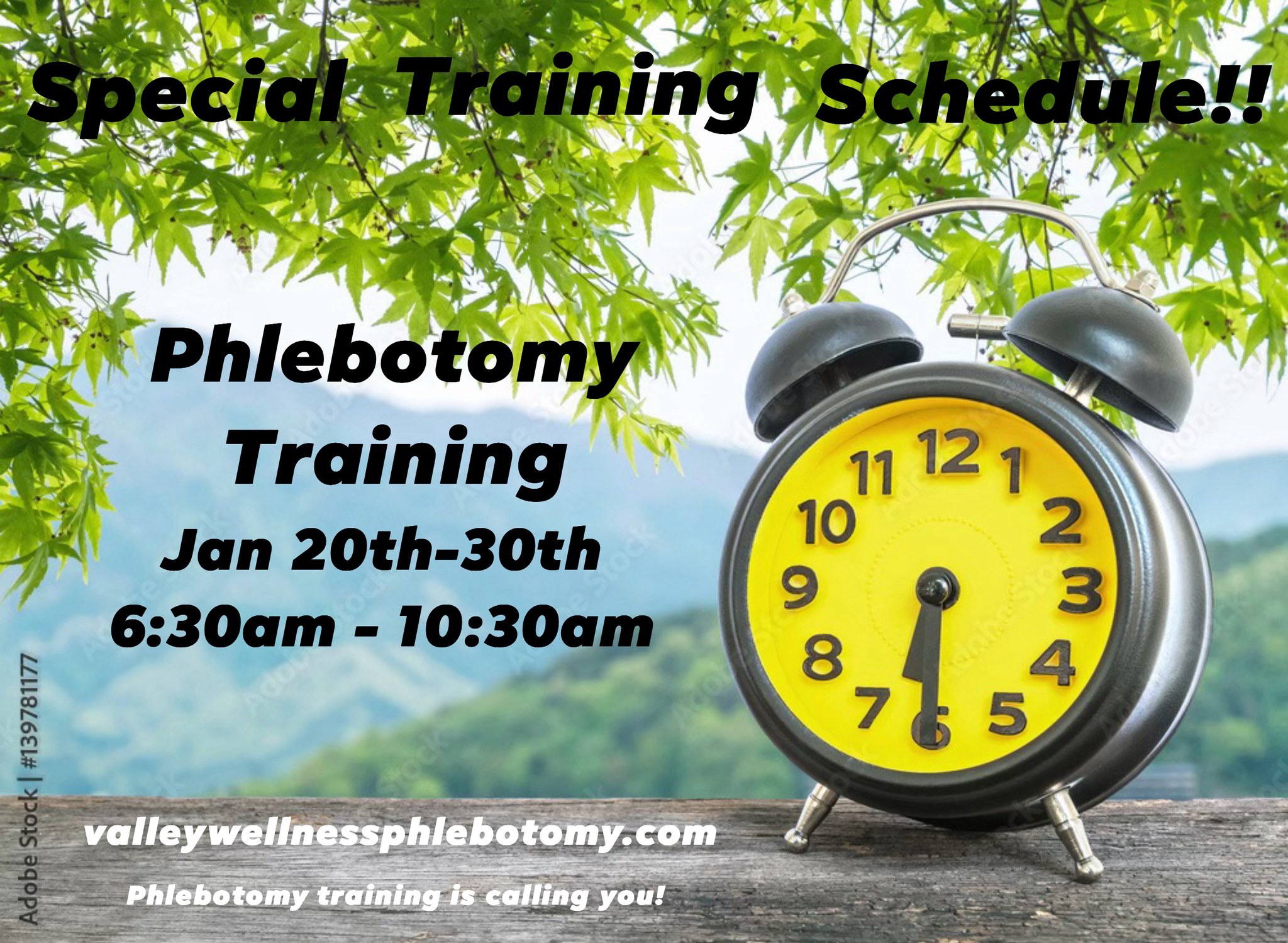
Early morning Phlebotomy Training
Tuesday Jan 20 – Friday Jan 30
No class on the weekend

Why a Phlebotomist?

  • 106,153 Current Phlebotomy Jobs hiring across the Nation.
  • The U.S. Bureau of Labor Statistics projects 22% growth from 2020 to 2030 in employment of phlebotomists, that is faster than the average for all occupations.
  • Employment opportunities are in-demand at
    Plasma Donation Centers, Medical Clinics, Blood Banks, Health fairs, Platelet donation centers, Dialysis clinics, Sedation dentistry, Hospitals, Laboratories, Paramedical examination and Physicians offices.

getting Attention With The Perfect Phlebotomy Resume

Securing a phlebotomy job requires a strong cover letter and resume that stand out to potential employers. These documents are your first chance to make an impression, showcasing your skills and experience. Crafting them thoughtfully can significantly improve your chances of landing your desired position in phlebotomy, as both the cover letter and resume play essential roles in the application process.

The cover letter introduces you to the hiring manager, allowing you to express your enthusiasm for the role and highlight specific qualifications that make you a strong candidate. It also offers the opportunity to showcase your personality and passion for phlebotomy while addressing any gaps or career changes that may not be apparent from your resume.

Customizing your cover letter to the job description and addressing the hiring manager directly can help convey a genuine interest in the role.

Your resume is a detailed snapshot of your professional qualifications, including your work experience, certifications, and technical skills relevant to phlebotomy. A well-organized resume demonstrates attention to detail and highlights your ability to perform key tasks like venipuncture techniques and managing laboratory equipment. By showcasing your qualifications and personalizing your application materials, you can significantly improve your chances of securing a phlebotomy position.

Frequently Asked Questions

Here are some questions you may have and the answers associated with them:

Phlebotomists’ pay differs a lot depending on where they work, their experience, and who they work for. According to the Bureau of Labor Statistics, the average phlebotomist makes about $41,000 a year. That is about $20.10 an hour if they work 40 hours a week. However, these numbers can change a lot.
Phlebotomists just starting out usually make less than the average. At the beginning of their career, they might earn between $14 and $18 an hour. As they gain more experience and get more certifications, their chances of earning more increase.
Phlebotomists with many years of experience can expect their pay to go up. After five years or more, they might make between $22 and $27 an hour. Those with special skills or supervisory roles might earn even more.
To earn as much as possible, phlebotomists should aim to get thorough training, seek out certification, and gain experience in different work environments. Being active in professional groups and continuing your education is also important for moving up in this field.

Understanding the Basics: Course Content
Phlebotomy training courses teach you all the essential skills to draw blood correctly. They also teach about the body, especially the circulatory system, helping you find the right veins and understand how blood collection works.
You’ll also learn about the different parts of the blood and the tests that doctors use it for. A big part of the training is knowing how to handle and process blood samples properly. Keeping everything clean and safe is very important to avoid any risk of infection.
Through practice and lessons, you’ll gain the skills and confidence needed to be a good phlebotomist, which is crucial for fast and accurate healthcare.

Hands-On Skills: Techniques and Practices

In addition to bookwork, learning by doing is a major part of your training. You will practice how to safely and effectively draw blood from veins and capillaries. Training also teaches you to identify patients correctly, label blood samples well, and handle and transport them safely.
Practicing these skills helps reduce patients’ discomfort and ensures the blood samples are kept in good condition. As a result, this practice helps you become skilled and confident, making you ready to provide excellent patient care in any healthcare setting.

Certification Preparation

After finishing your training, it’s important to get certified. Indeed, certification shows that you meet the required skills and knowledge to work as a phlebotomist. To get ready for the certification exam, you’ll want to review your study material and take some practice tests.

Phlebotomy is one of the most important processes in medicine. Did you know that 70% of medical decisions are made from laboratory tests resulting from phlebotomy? It’s so crucial that many of our treatments today wouldn’t be possible without it. Though it might seem simple, the role of phlebotomists is essential in keeping people healthy.

If you’ve ever gotten your blood tested, you’ve probably met a phlebotomy technician. These are important healthcare workers, but what does a phlebotomy technician do exactly? They mainly collect blood from people. Doctors use this blood to find out what illnesses you might have, see if treatments are working, or do research.

1. Hospital Phlebotomist

2. Clinical Laboratory Phlebotomist

3. Donation Center and Mobile Phlebotomist

4. Research Phlebotomist

5. Insurance Examiner

6. Educator

7. Specialized Phlebotomist

8. Forensic Phlebotomist

Come visit our location in St George!

Valley Wellness Phlebotomy:
2736 Red Cliffs Dr, Set 2
St George, UT 84790